
Why Laravel is the Most Preferred PHP Framework for Modern Web Development?
Laravel is one of the most popular PHP frameworks used by startups, agencies, and enterprise companies to build secure, scalable, and high-performance web applications. Learn why Laravel is widely adopted, its advantages, and where it is used in real-world projects.
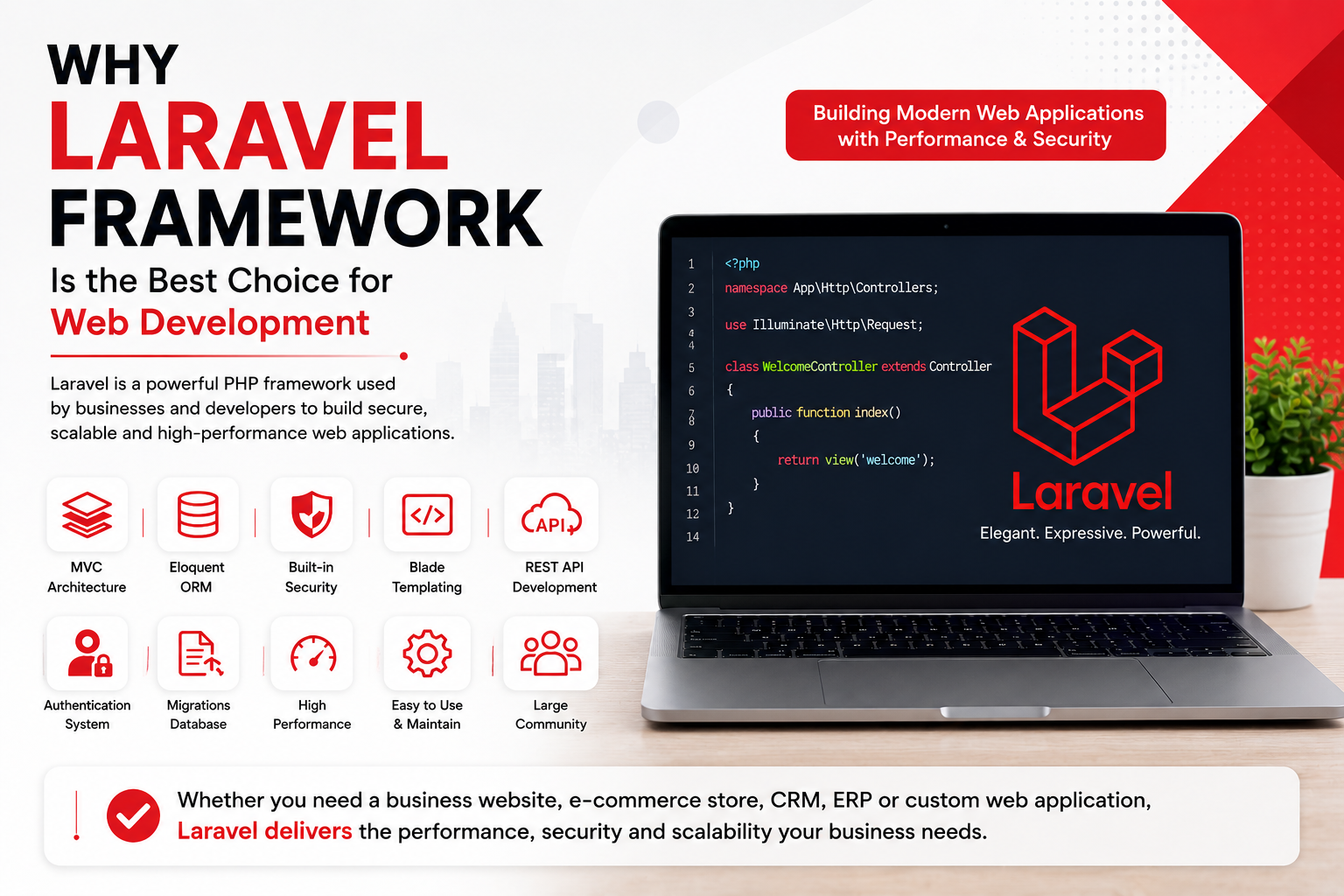
Why Laravel is the Most Preferred PHP Framework for Modern Web Development
In today's fast-paced software industry, businesses need web applications that are secure, scalable, maintainable, and easy to develop. Among the many PHP frameworks available, Laravel has become the first choice for developers and companies worldwide.
Whether you're building a company website, an e-commerce platform, a SaaS product, or an enterprise management system, Laravel provides everything needed to build modern applications efficiently.
What is Laravel?
Laravel is an open-source PHP framework that follows the MVC (Model-View-Controller) architecture. It was created to simplify web development by providing clean syntax, built-in tools, and powerful features.
Laravel helps developers write less code while creating secure and scalable applications.
Why Do Traditional Companies Choose Laravel?
Many traditional software companies, digital agencies, and enterprise organizations use Laravel because it offers:
- Clean and organized project structure
- Faster development process
- High security
- Easy database management
- Built-in authentication system
- REST API development
- Excellent performance
- Large developer community
- Long-term maintainability
- Easy integration with third-party services
These advantages reduce development time and maintenance costs while improving application quality.
Key Features of Laravel
1. MVC Architecture
Laravel follows the MVC design pattern, making projects easier to organize, maintain, and scale.
Benefits:
- Better code organization
- Easier debugging
- Improved teamwork
- Faster development
2. Eloquent ORM
Laravel's Eloquent ORM allows developers to work with databases using PHP models instead of writing complex SQL queries.
Example:
$users = User::all();
This makes database operations cleaner and more readable.
3. Built-in Authentication
Laravel includes authentication features such as:
- Login
- Registration
- Password reset
- Email verification
- Role-based access control
Developers can implement secure user authentication quickly.
4. Routing System
Laravel provides a simple and powerful routing system.
Example:
Route::get('/about', function () {
    return view('about');
});
Routes are easy to understand and maintain.
5. Blade Template Engine
Blade is Laravel's templating engine that allows developers to build reusable layouts and dynamic web pages efficiently.
6. Database Migrations
Laravel migrations help developers manage database changes using version-controlled PHP files.
Benefits include:
- Team collaboration
- Easy deployment
- Database consistency
- Rollback support
7. Security
Laravel provides built-in protection against:
- SQL Injection
- Cross-Site Scripting (XSS)
- Cross-Site Request Forgery (CSRF)
- Password hashing
- Authentication attacks
Security is one of Laravel's strongest advantages.
8. Queue System
Heavy tasks such as sending emails, notifications, or generating reports can be processed in the background using Laravel Queues.
This improves application performance and user experience.
9. API Development
Laravel makes it easy to build secure REST APIs for:
- Mobile applications
- React applications
- Next.js applications
- Flutter applications
- Third-party integrations
10. Package Ecosystem
Laravel offers many official packages, including:
- Laravel Sanctum
- Laravel Passport
- Laravel Horizon
- Laravel Cashier
- Laravel Scout
- Laravel Socialite
These packages reduce development effort significantly.
Where is Laravel Used?
Laravel is suitable for building:
- Business websites
- Corporate portals
- CRM systems
- ERP software
- School management systems
- Hospital management systems
- Restaurant management platforms
- E-commerce websites
- Booking systems
- SaaS platforms
- Job portals
- Real estate websites
- Learning management systems (LMS)
- Admin dashboards
Its flexibility makes it suitable for projects of all sizes.
Why Developers Love Laravel
Laravel improves developer productivity by offering:
- Elegant syntax
- Excellent documentation
- Strong community support
- Rapid application development
- Easy testing
- Built-in tools
- Scalable architecture
- Modern development practices
These features allow developers to focus more on business logic instead of repetitive coding tasks.
Advantages for Businesses
Businesses benefit from Laravel because it offers:
- Faster project delivery
- Reduced development costs
- High security
- Easy maintenance
- Better scalability
- Reliable performance
- Long-term support
- Easy integration with payment gateways, APIs, and cloud services
This makes Laravel an excellent investment for modern digital products.
Is Laravel Still Relevant in 2026?
Absolutely.
Laravel continues to evolve with modern PHP versions and regularly introduces new features that improve performance, developer experience, and scalability. Thousands of companies and millions of developers continue to use Laravel for building production-ready applications.
Conclusion
Laravel has established itself as one of the most trusted PHP frameworks for modern web development. Its elegant syntax, robust security, built-in tools, and scalability make it an excellent choice for startups, agencies, and enterprise organizations alike.
Whether you're building a small business website or a large-scale SaaS platform, Laravel provides the flexibility, reliability, and performance needed to deliver successful web applications.